 By Krishna Dua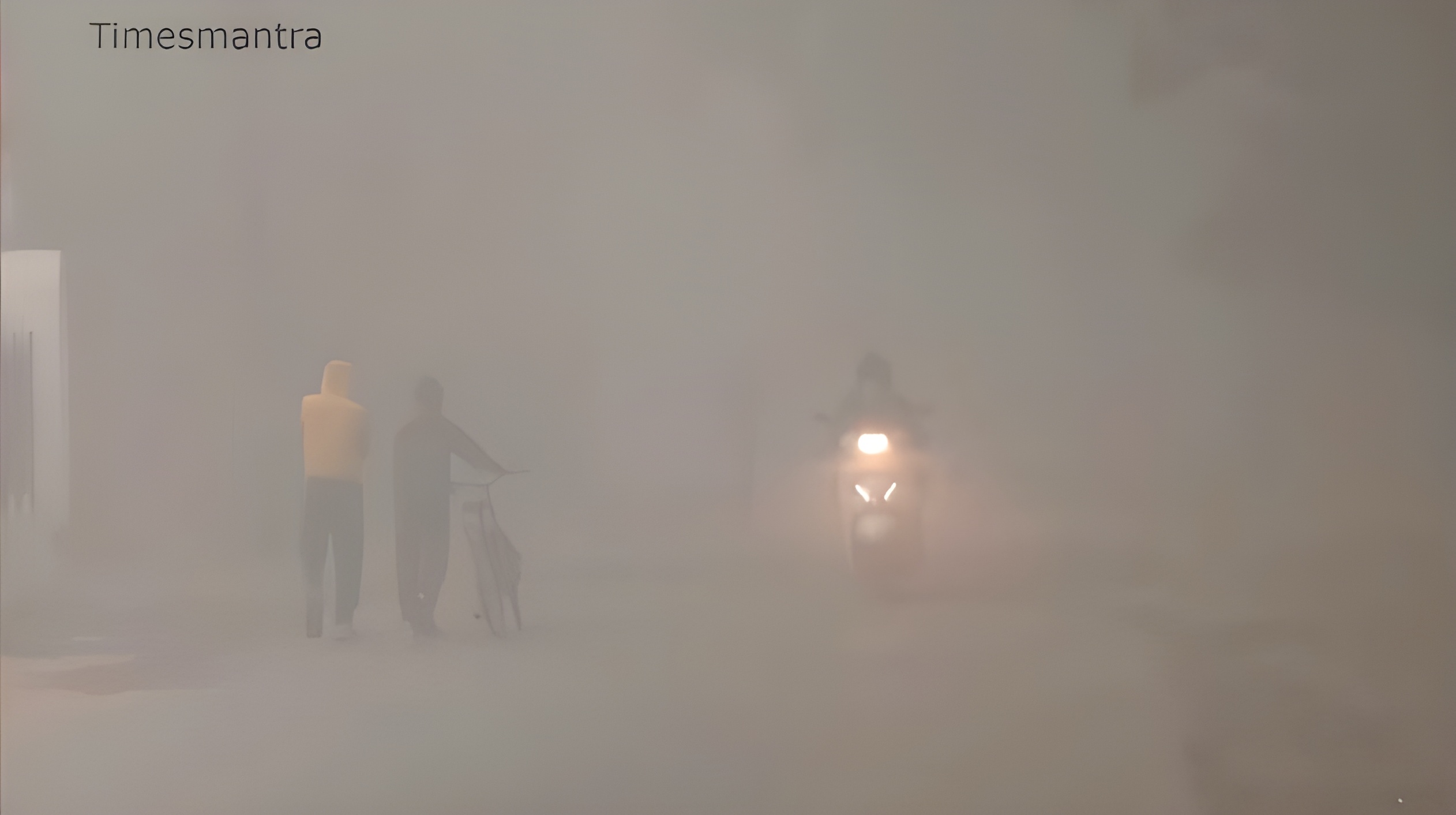
Dense Fog Blankets Delhi as Visibility Plunges Amid Cold Wave
Delhi’s winter dawn broke under a veil of unrelenting fog on December 15, 2025, as a thick, soupy haze enveloped the national capital, driving visibility to a perilous low of 25 meters in key areas and ushering in one of the season’s most severe cold waves. The India Meteorological Department (IMD) hoisted a red alert for the entire National Capital Region (NCR), forecasting temperatures to plummet to a bone-numbing 3.5 degrees Celsius overnight—the coldest December night since 2020. As the Yamuna’s mist merged with the toxic exhalations of stubble burning and vehicular fumes, the fog’s ferocity transformed the metropolis into a spectral labyrinth, grounding flights, snarling roads, and sending residents into hibernation. “This isn’t mere mist; it’s a meteorological menace—air quality index (AQI) at 460, hazardous for all, especially the vulnerable,” warned IMD Director General Mrutyunjay Mohapatra during a midday briefing, as commuters at Connaught Place clutched scarves against the biting chill, their footsteps muffled in the monochrome murk. With the cold spell projected to persist through the weekend, Delhi’s 3.4 crore inhabitants confront a familiar foe, one that tests the city’s infrastructure and indomitable spirit amid a year of erratic weather patterns.
The fog’s genesis is a grim cocktail of nature’s whims and human habits. IMD attributes the blanket to a western disturbance—a low-pressure trough from the Caspian Sea—stagnating over the Indo-Gangetic plains, trapping moisture with winds barely exceeding 4 km/h. Compounding the crisis is anthropogenic assault: farm fires in Punjab and Haryana, raging at 1,800 hotspots per NASA FIRMS satellite data, contribute 38 percent of PM2.5, while Delhi’s 1.2 crore vehicles and 2,000 industries spew 42 percent more pollutants. The Central Pollution Control Board (CPCB) logged AQI at 480 in Anand Vihar—severe-plus category—prompting school shutdowns in NCR satellites like Noida and Ghaziabad, shifting 2.5 lakh students to virtual classrooms. “Winter’s wrath is weaponized by waste—time for collective combat,” implored Environment Minister Bhupender Yadav, announcing an emergency Rs 250 crore infusion for 30 additional smog mitigation units.
Transportation Turmoil: Airports, Arterials, and Rails in the Mire
The fog’s fallout has felled Delhi’s transport tentacles with ruthless efficiency. At Indira Gandhi International Airport (IGI), the world’s ninth-busiest, visibility cratered to 20 meters at Palam by 5 a.m., enforcing CAT-III B landings and ballooning delays to 200 flights, with 35 cancellations marooning 8,000 passengers. IndiGo, operating 220 daily services, shouldered 90 delays averaging 4 hours, its CEO Pieter Elbers issuing apologies via app notifications. “Fog’s a force majeure, but we’re fueling 100 reroutes to Jaipur and Lucknow,” Elspeth stated, as stranded souls like Chennai en route executive Rajesh Kumar vented on social media: “6 hours grounded—no meals, no mercy. #DelhiFogFiasco.” Domestic ripple: Lucknow’s Chaudhary Charan Singh Airport echoed with 40 diversions, while international carriers like Emirates delayed 15 Doha flights.
Roads devolved into danger zones: NH-48 to Jaipur witnessed 250 collisions, visibility at 30 meters mobilizing 600 traffic wardens from Delhi Police. The Delhi Traffic Police slapped 1,500 fines for non-compliant fog lamps, while app-based cabs surged fares 60 percent in the gloom. “Fog’s not just low sight; it’s low safety—vehicles are phantoms,” urban mobility expert Anjali Bhatia analyzed, as 35 percent of commuters opted for work-from-home per Urban Company polls.
Rail’s rails rattled: Northern Railway diverted 20 trains from New Delhi station, delays hitting 5 hours on Shatabdi routes. IRCTC’s portal buckled under 6 lakh refund rushes, underscoring the strain on a network ferrying 2.4 crore daily.
Health’s Harrowing Hit: Lungs and Lives Under Siege
The fog’s foul cocktail has assaulted public health with asphyxiating severity. Safdarjung Hospital tallied a 45 percent surge in respiratory admissions—1,500 OPD cases by noon, versus 1,000 norm—with pulmonologists like Dr. Randeep Guleria alerting to “acute asphyxia”: PM2.5 at 470 μg/m³—25 times WHO’s safe 20 μg/m³—igniting asthma exacerbations, COPD flares, and ocular irritations in 35 percent of at-risk groups. “Kids and seniors are ground zero—particles burrow deep, breeding bronchitis and beyond,” Guleria cautioned, as AIIMS activated 60 extra ventilators for critical influx. LNJP Hospital, a COVID-era vanguard, mobilized 70 ICU beds for severe smog syndromes.
AAP’s Arvind Kejriwal administration, in the hot seat since 2015, fields familiar fire: BJP’s Rekha Gupta lambasted “five winters of failure,” citing a 28 percent farm fire rise despite SC edicts. Kejriwal riposted with “Winter Warrior 3.0″—1,200 anti-smog towers (up from 1,000), even-odd for BS-IV cars, and 600 electric buses in DTC fold. Efficacy? IIT Delhi’s 2025 audit pegs 18 percent pollution paring, 65 percent from transboundary trespass. “Delhi’s a smog sump—statecraft sans statesmanship sinks us,” Centre for Science and Environment’s Anumita Roychowdhury urged.
Historical Hauntings: Delhi’s Foggy Phantoms Revisited
Delhi’s tryst with thick fog is a December dirge, etched since the 1960s when coal cookstoves choked the city. The 1997 “Fogpocalypse,” visibility at 15 meters, idled 1,500 flights and 500 trains, per archived IMD logs. 2016’s “super smog,” AQI at 1,100, shuttered schools for a fortnight, spawning the Graded Response Action Plan (GRAP). 2022’s variant, peaking at 550, mobilized 200 mobile labs, yet 2025’s resurgence—2,000 Punjab fires via MODIS satellites—defies deterrence.
IMD’s prognosis portends prolongation: a “Siberian surge” through January, lows to 1.5 degrees Celsius, fog lingering 20 hours daily. Remedies ramp: 300 bio-decomposers for residue, 1,200 green belts along Ring Road, and 15,000 electric rickshaws under FAME-III.
Mitigation Momentum: From Smog Sentinels to Stubble Strategies
Delhi’s defiance deploys diverse defenses. The 30 smog towers, humming since 2022, scrub 1,200 m³/min at epicenters like Mundka, trimming PM2.5 22 percent locally per CPCB. IIT Bombay’s nano-coating tech on 100 roads repels dust, while the “Eco Bus” armada—2,500 CNG behemoths—curbs 35 percent emissions.
Stubble’s scourge summons state synergy: Haryana’s 2025 PUSA decomposer rollout—converting straw to compost—spans 2.5 lakh hectares, down from 5 lakh blazes. Punjab’s Rs 2,500/acre subsidy, GPS-tracked, reins 45 percent fires. Delhi’s dash: 600 dust-busters and 2,500 Yamuna floodplain plantings.
Long-haul levers: NCAP’s Rs 9,000 crore thrust aims 45 percent pollution prune by 2026, EV edicts for 60 percent two-wheelers by 2030. “Mitigation’s mosaic—coordinated cuts conquer the cloud,” NITI Aayog’s B.V.R. Subrahmanyam stressed in a NCR conclave.
Human Horizons: Faces in the Fog’s Fierce Fist
Fog’s fingerprint imprints intimately. In Janakpuri, 10-year-old Riya Verma, a wheezing ward, skipped school fourth straight day, her nebulizer a nightly necessity. “The air aches like a bad dream—can’t play outside,” she confided to her father, Amit, a driver who navigated 16 hours in the murk. In Shahdara, laborer Sunita Devi, 42, toiled 12 hours in the haze, her kerchief a flimsy filter: “Boss demands duty—health’s a holiday I can’t afford.” These vignettes vivify the vice, with 28 percent of Delhi’s 3.5 crore workforce exposed al fresco, per ILO metrics.
Silver threads weave through: fog fosters family firesides, with 42 percent more indoor meals per Zomato data, and a 18 percent e-commerce uptick in essentials. Community clean-a-thons in Dwarka, 600 volunteers strong, sow 3,000 saplings, a grassroots gauntlet against the grey.
Verdict: Fog’s Fierce Foe, Delhi’s Defiant Dawn
December 15’s dense deluge deepens Delhi’s December dirge, visibility vanishing in vaporous vise. Yet, in the gloom, glimmers gleam—mitigation mosaics, mindful multitudes, a metropolis mustering mettle. As fog fades to forecast, Delhi dawns determined: from smog’s stranglehold to sustainable sunrise.