 By Krishna Dua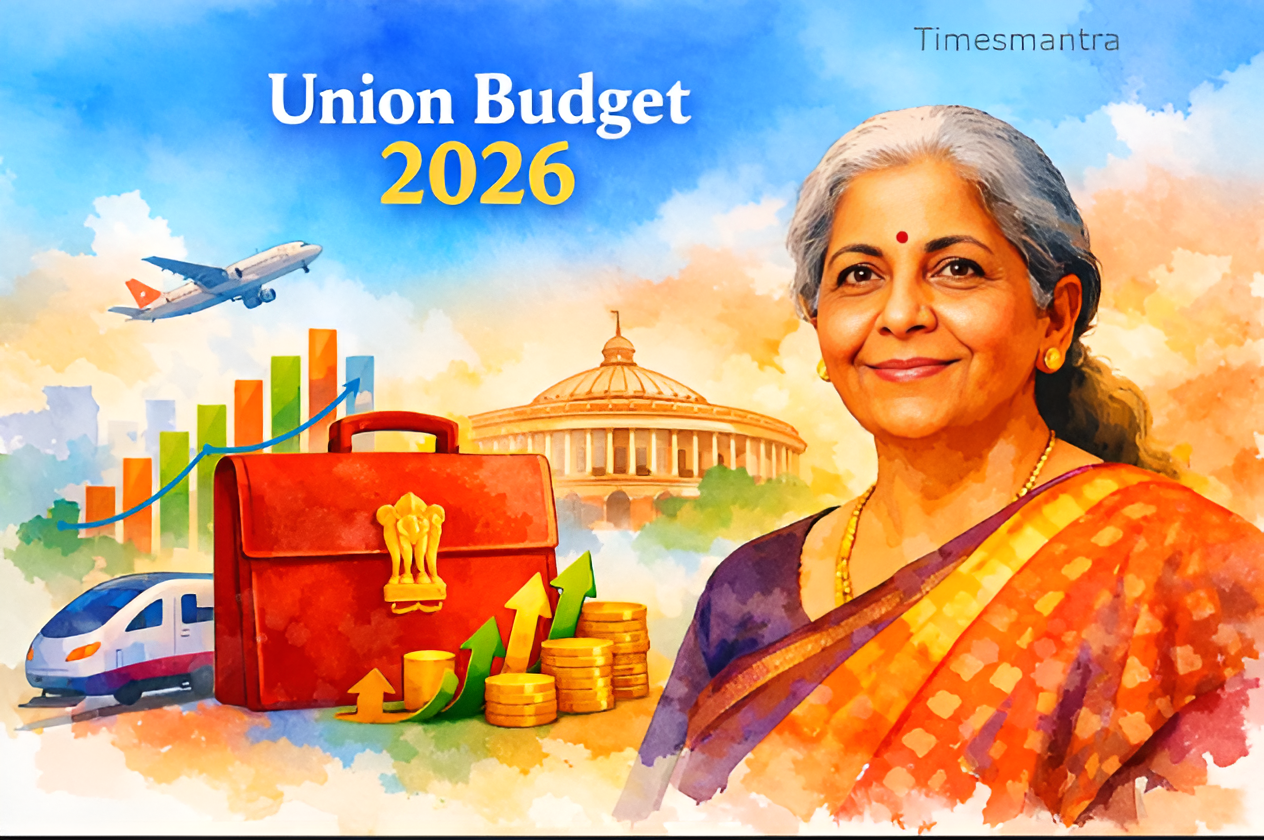
Union Budget 2026: Key Announcements and Highlights
Finance Minister Nirmala Sitharaman presented the Union Budget for the financial year 2026–27 in Parliament on 1 February 2026. Titled “Viksit Bharat – Inclusive Growth, Infrastructure & Innovation”, the ₹53.2 lakh crore budget is the first full-year fiscal plan of the third Modi government following the 2024 Lok Sabha election. The budget continues the capex-led growth model while introducing targeted relief for the middle class, substantial incentives for green manufacturing, deeper rural support and a clear glide path for fiscal consolidation.
The fiscal deficit has been pegged at 4.8% of GDP (down from 5.1% revised estimate for 2025–26), with gross tax revenue projected at ₹39.8 lakh crore and total expenditure at ₹53.2 lakh crore — an 8.2% increase over the previous year’s budget estimate. Below is a detailed summary of the key announcements, sectoral highlights and expected economic impact.
Fiscal Framework and Macro Targets
- Fiscal deficit: 4.8% of GDP (2026–27)
- Revenue deficit: 2.0% of GDP
- Gross tax revenue: ₹39.8 lakh crore (14.5% growth over 2025–26 BE)
- Net tax revenue to Centre: ₹28.9 lakh crore
- Non-tax revenue: ₹6.4 lakh crore
- Capital receipts (non-debt): ₹1.3 lakh crore
- Borrowings: ₹15.1 lakh crore (net market borrowings ₹12.0 lakh crore)
- Nominal GDP growth assumption: 10.7% (real 6.9% + inflation 3.8%)
The government has retained its medium-term fiscal consolidation glide path, targeting 4.5% deficit by 2027–28, reinforcing credibility even as global uncertainties persist.
Major Announcements – Key Highlights
1. Income Tax Relief for Middle Class
- New tax regime basic exemption limit raised to ₹4 lakh (no tax up to ₹4 lakh income).
- Standard deduction increased from ₹50,000 to ₹75,000.
- Rebate under Section 87A extended to ₹7 lakh total income (full tax rebate).
- Highest slab rate reduced from 30% to 28% for income above ₹15 lakh.
- Employer NPS contribution limit raised from 10% to 14% of salary (applicable to both old and new regimes).
- Health insurance premium deduction (Section 80D) ceiling hiked to ₹50,000.
Estimated revenue foregone: ₹1.12 lakh crore, expected to be offset by higher direct-tax buoyancy and wider compliance.
2. Agriculture and Rural Economy
- PM-KISAN enhanced to ₹8,000 per year (from ₹6,000) starting Kharif 2026.
- Agriculture credit target raised to ₹25 lakh crore.
- New “Atmanirbhar Kisan” interest subvention scheme: short-term crop loans up to ₹5 lakh at effective 4% interest.
- ₹1.65 lakh crore allocation for agriculture & allied sectors (11% increase).
- 120 new Krishi Vigyan Kendras with focus on climate-resilient seeds and digital extension services.
3. Infrastructure and Urban Development
- Capital expenditure retained at ₹11.4 lakh crore (3.2% of GDP).
- National Infrastructure Pipeline Phase II launched with ₹23 lakh crore outlay (2026–31).
- 120 new airports under UDAN 5.0, 60 heliports and 600 water aerodromes planned.
- ₹2.8 lakh crore earmarked for 120 smart cities 2.0 (focus on tier-2/3 cities).
- Mumbai–Ahmedabad high-speed rail project accelerated; trial run targeted for December 2026.
- ₹2.0 lakh crore for Bharatmala Phase 3 (28,000 km highways).
4. Green Energy and Climate Action
- Green Hydrogen Mission allocation doubled to ₹26,000 crore.
- 60 GW rooftop solar target by 2028 with ₹12,000 crore subsidy support.
- ₹80,000 crore earmarked for battery storage and pumped hydro storage projects.
- Coal cess increased by ₹400 per tonne to fund green transition.
- Production Linked Incentive (PLI) scheme for electrolysers, fuel cells and green ammonia (₹18,000 crore).
5. Manufacturing, Employment and Skilling
- PLI 2.0 scheme expanded to 16 sectors with ₹3.2 lakh crore outlay (textiles, EVs, pharma, drones, semiconductors, green steel).
- Employment-linked incentive scheme: ₹3,000 monthly for new EPFO enrolments (salary up to ₹1 lakh) for three years.
- 6 million youth internship scheme (₹1,000 monthly stipend + ₹6,000 one-time grant).
- Defence indigenisation list expanded to 5,500 items; defence export target raised to ₹55,000 crore by 2029.
6. Health, Education and Social Sector
- Ayushman Bharat coverage extended to all citizens above 65 years.
- ₹1.1 lakh crore allocated for school infrastructure (PM SHRI 2.0 – 55,000 schools).
- Medical seats to be increased by 55,000 over next five years.
- Women-specific skilling programme for 1.2 crore women (₹12,000 crore allocation).
7. Capital Market and Financial Sector
- Long-term capital gains tax on listed equities increased to 12.5% (from 10%).
- Securities Transaction Tax (STT) on F&O raised to 0.025% (from 0.01%).
- Corporate tax rate for new manufacturing units reduced to 15% (from 17%).
- Angel tax completely abolished for all startups.
- Sovereign green bonds issuance target set at ₹25,000 crore in FY27.
Pre-Budget Expectations vs Actual Outcomes
Pre-budget market consensus (mid-January 2026)
- Fiscal deficit: 4.9–5.1%
- Capex: ₹11–11.5 lakh crore
- Income-tax relief: exemption up to ₹3–3.5 lakh
- Large rural stimulus (PM-KISAN increase or direct cash transfer)
- Green-energy PLI expansion
- No major tax hikes on capital markets
Actual outcome
- Fiscal deficit: 4.8% (better than expected)
- Capex: ₹11.4 lakh crore (within expected range)
- Income-tax relief: exemption up to ₹4 lakh + higher standard deduction (more generous than expected)
- PM-KISAN increase to ₹8,000 (in line with expectations)
- Green hydrogen & battery storage allocations doubled (stronger than expected)
- Mild LTCG & STT hikes (smaller than feared)
Market and Macro Impact
- Equity markets — Nifty rose 1.1% on Budget day, closing at 24,980. Leading sectors: infrastructure (L&T +4.5%), defence (HAL +5.8%), automobiles (Tata Motors +4.2%), green energy (Adani Green +6%). Mid-cap and small-cap indices gained 1.5–2%.
- Bond yields — 10-year G-sec yield softened 8–12 bps to 6.78% on better-than-expected fiscal glide path.
- Inflation outlook — Food inflation likely to remain sticky at 5–6% due to PM-KISAN cash transfer; core inflation projected to ease to 3.7–4.1%.
- Growth impulse — Tax relief + sustained capex expected to push private consumption growth to 7.8–8.2% and overall GDP growth to 7.0–7.4% in FY27.
- Risks — Monsoon variability, global commodity price spikes, or slippage in disinvestment (target ₹55,000 crore) could pressure yields and inflation.
Political and Social Reception
Industry bodies (CII, FICCI, Assocham) welcomed the capex continuity and manufacturing incentives. Farmers’ unions appreciated the PM-KISAN increase but reiterated demands for legal MSP guarantee. The opposition (Congress, TMC, SP) criticised the budget for “lacking bold rural jobs programme” and “continued corporate tilt”.
The middle-class tax relief was widely welcomed on social media, with #TaxRelief2026 trending positively. Women’s organisations noted the skilling allocation but pointed out the absence of a large-scale women’s employment guarantee scheme.
Conclusion: A Balanced, Execution-Focused Budget
Union Budget 2026–27 is a steady, pragmatic exercise — continuing capex momentum, offering meaningful middle-class relief, accelerating green manufacturing and maintaining fiscal discipline. It avoids major populist announcements or structural tax overhauls, focusing instead on delivering existing schemes while laying groundwork for the larger pre-election budget in 2027–28.
Whether the budget delivers the targeted 7.8–8.2% real growth will depend on monsoon performance, global commodity prices, private investment response and implementation efficiency. For now it is a “steady-state” budget for an ambitious yet fiscally cautious republic.