 By Krishna Dua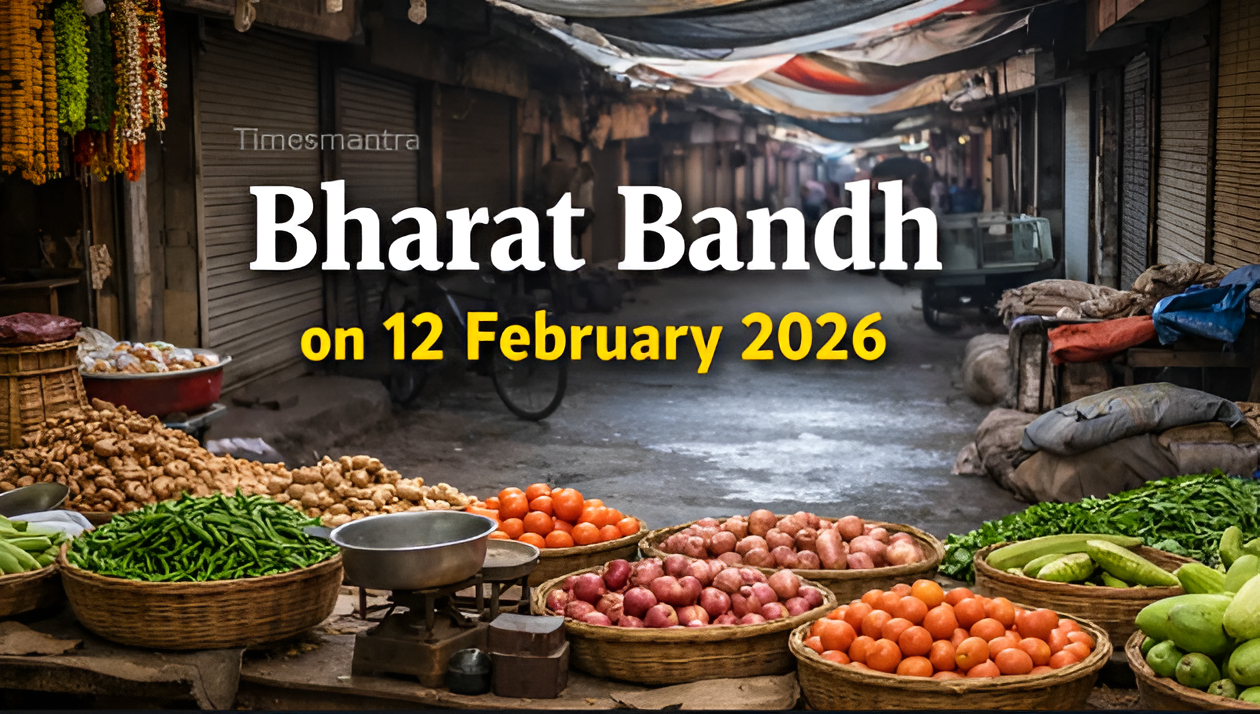
Bharat Bandh 12 Feb 2026: Services Affected
A nationwide Bharat Bandh has been called for Thursday, 12 February 2026 by a joint front of ten central trade unions (INTUC, AITUC, CITU, HMS, AIUTUC, TUCC, SEWA, AICCTU, LPF and UTUC) along with major farmers’ organisations including the Samyukta Kisan Morcha (non-political), Kisan Mazdoor Morcha and All India Kisan Sabha. The strike has been announced as a protest against what the organisers describe as “anti-worker, anti-farmer and anti-people policies” of the central government.
The call has received explicit or moral support from the entire parliamentary opposition, including Congress, Samajwadi Party, TMC, DMK, RJD, AAP, Left parties and several regional outfits. Most opposition-ruled states have already indicated they will not invoke the Essential Services Maintenance Act (ESMA) against the bandh participants.
Official Reasons for the Bandh Call
The joint platform released a 17-point charter on 3 February 2026. The principal demands are:
- Complete rollback of the four Labour Codes
- Legal guarantee of MSP at C2+50% for all crops with automatic procurement mechanism
- Immediate withdrawal of Electricity Amendment Bill 2022 provisions seen as anti-farmer
- Filling of 30 lakh central and state government vacancies
- Regularisation of all scheme workers (Anganwadi, ASHA, Mid-Day Meal, etc.)
- National minimum wage of ₹26,000 per month
- Minimum pension of ₹6,000 under EPS-95 for all unorganised workers
- Restoration of Old Pension Scheme for all government employees
- Scrap NPS and return to OPS
- Halt privatisation of PSUs and Indian Railways
- End contract labour system in government and public-sector undertakings
- ₹15,000 monthly pension for all senior citizens
- ₹10,000 monthly unemployment allowance
- Universal social security for gig and platform workers
- Immediate repeal of Agnipath scheme
- End to forced digital transactions and Aadhaar linkage for welfare schemes
The trade unions and farmers’ bodies have stated that if no positive response is received from the government by the evening of 10 February, the bandh will be observed “fully and completely” on 12 February.
Expected Impact on Essential & Non-Essential Services
The bandh has received near-total backing from central trade unions, most transport unions, construction workers’ federations, street-vendor associations, small-shop owners’ bodies and several state-level government employees’ unions.
Services likely to remain fully or largely closed / affected:
- State-run buses (most State Road Transport Corporations)
- Private long-distance buses and tourist buses
- Auto-rickshaws, e-rickshaws, cycle-rickshaws and app-based taxis (except airport & hospital emergency)
- Goods transport (truck & tempo movement expected to be severely hit on national highways)
- Construction sites (almost complete shutdown across urban & rural areas)
- Small retail shops, kirana stores, vegetable & fruit mandis (especially in smaller towns & rural areas)
- Street food vendors, tea stalls, dhabas on highways
- Coal mines, steel plants, cement plants, fertiliser plants (major public-sector units)
- Loading–unloading operations at railway goods sheds and inland container depots
- Government offices (except emergency & essential services) in opposition-ruled states and many BJP-ruled districts where unions are strong
- Schools & colleges (majority expected to declare holiday; CBSE & state boards have issued no advisory against it)
- Markets in rural & semi-urban areas (mandis, haats, weekly bazaars)
Services expected to remain open (partial or full):
- Banks (RBI has declared normal banking hours; private banks will follow)
- ATMs and digital payment systems
- Hospitals, nursing homes, pharmacies, ambulances, blood banks
- Airports (domestic & international flights operating normally)
- Railways (passenger trains running; goods trains may face delays)
- Metro services in Delhi, Kolkata, Mumbai, Bengaluru, Chennai, Hyderabad (decision pending; likely to run with reduced frequency)
- Petrol pumps & CNG stations (most expected to remain open)
- Telecom services, internet, electricity supply
- Print & electronic media offices
- IT parks & software companies (most private-sector offices expected to remain open)
- Large organised retail (malls, supermarkets, Reliance Retail, DMart, Big Bazaar) in major urban centres
State-wise Impact Assessment
- Punjab, Haryana, Western UP: Near-total bandh expected in rural & semi-urban areas; national highways likely to see blockades & tractor-trolley protests
- Bihar, Jharkhand, Odisha, Chhattisgarh: Strong support from trade unions & farmers; transport & markets expected to be shut
- West Bengal: TMC has extended moral support; state transport & markets likely to be affected
- Maharashtra, Madhya Pradesh: Mixed impact; rural areas observe strong bandh, urban centres partial
- Delhi-NCR: Metro & essential services open; markets & small shops likely closed
- South India (TN, Karnataka, Andhra, Telangana): Partial impact; trade unions strong but farmers’ support limited
- North-East & Himalayan states: Low to moderate impact
Government & Opposition Positions
The central government has described the bandh as “politically motivated” and urged all essential services to remain functional. Union Labour Minister Bhupender Yadav stated:
“We have held 48 rounds of tripartite talks on Labour Codes. The codes are in public interest. We urge citizens to go about their normal activities.”
Opposition leaders have extended full support:
- Rahul Gandhi: “Farmers and workers are fighting for their survival. Congress stands with them.”
- Sharad Pawar: “The government must listen before it is too late.”
- Mamata Banerjee: “Bengal will observe the bandh in solidarity.”
- Akhilesh Yadav: “SP workers will support the bandh fully.”
Conclusion
The Bharat Bandh called for 12 February 2026 is shaping up to be one of the most widespread industrial actions in recent years. With near-total backing from central trade unions, farmers’ bodies, transport unions and street-vendor associations, large parts of rural and semi-urban India—especially in the northern and eastern belts—are expected to observe a near-complete shutdown.
While essential services, digital payments, hospitals, airports and railways will continue, the bandh is likely to severely disrupt road transport, construction, small retail, mandis and government offices in many districts. The real test will be the scale of participation in NDA-ruled states and the extent to which normal life is affected in major metros.
Whatever the final turnout, the 12 February bandh has already achieved one objective: it has brought the long-pending demands of workers and farmers back into national headlines just months before several state elections and a year ahead of the 2029 Lok Sabha polls.