 By Krishna Dua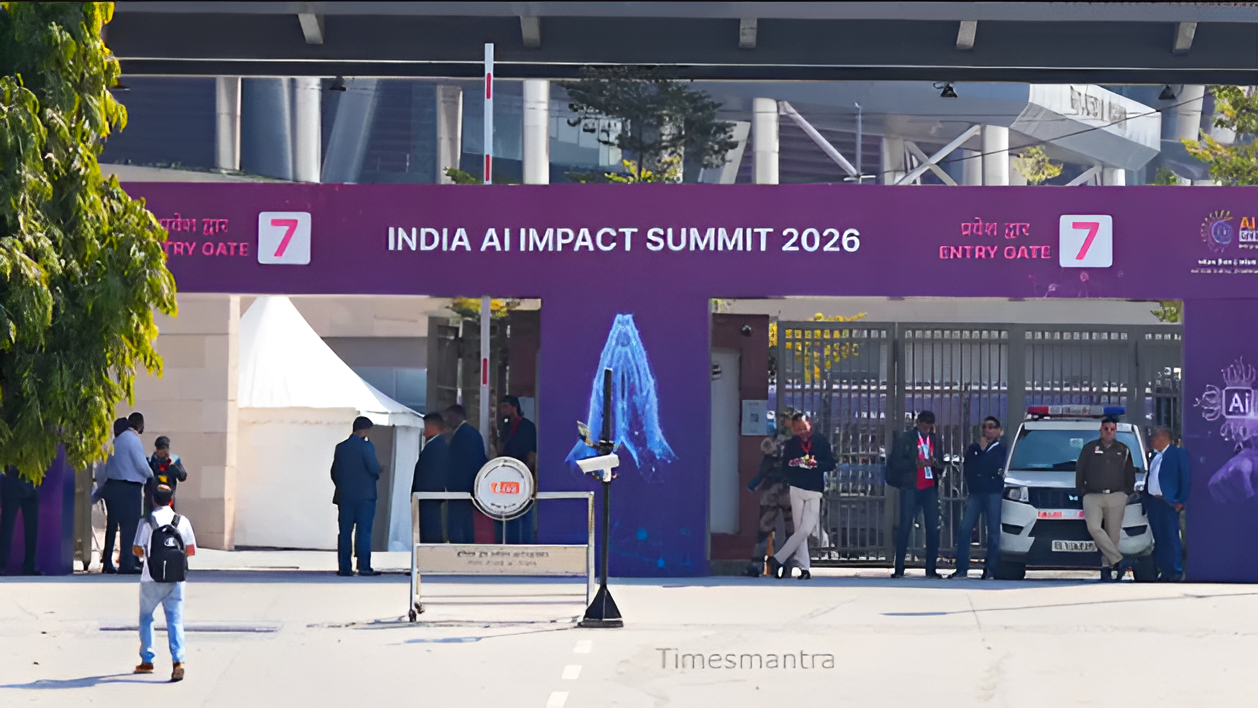
AI Summit 2026 Delhi: Global Leaders & Key Talks
The Bharat AI Conclave 2026 (commonly referred to as the India AI Summit 2026) concluded in New Delhi on 13 February 2026 after three days of high-level deliberations at Bharat Mandapam. Organised jointly by the Ministry of Electronics & Information Technology (MeitY), NITI Aayog, the IndiaAI Mission and NASSCOM, the summit drew more than 19,000 delegates, 240+ speakers and official delegations from 46 countries. Prime Minister Narendra Modi formally opened the event on 11 February and returned for the closing session on 13 February to announce several landmark initiatives.
The summit is widely regarded as the most significant AI policy-industry gathering in India since the IndiaAI Mission was approved in March 2024. It served as the global stage for unveiling India’s detailed sovereign AI compute roadmap, open-model strategy and safety framework for 2026–2030.
Prime Minister’s Key Announcements
In his inaugural address (11 February) and closing remarks (13 February), PM Modi made the following headline declarations:
- Sovereign AI compute capacity target raised from 10,000 GPUs (2025 baseline) to 100,000 GPUs by December 2027 and 1 million GPUs by 2030
- First public 25,000-GPU cluster (“Bharat GPT Cloud”) to go live in Q3 2026 at C-DAC Pune and IIT Madras
- IndiaAI Mission budget increased from ₹10,372 crore to ₹18,000 crore over five years
- Dedicated ₹2,000 crore “AI for Bharat Bhasha” fund to build open-source LLMs in 22 scheduled languages + 50+ classical and tribal languages by 2028
- Mandatory AI safety & ethics certification for all models above 10 billion parameters effective 1 July 2026
- Establishment of AI Safety Institute India (ASI-India) under MeitY with initial 350-member team
- ₹500 crore “AI for Public Good” grand challenge launched on 12 February with first call for proposals open till 30 April 2026
Major Policy & Regulatory Releases
- India AI Compute Roadmap 2026–2030 Targets 1 million public + private GPUs by 2030, with 40 % reserved for open-source and public-good models. Three national AI data centres announced: Pune (C-DAC), Chennai (IIT Madras), Guwahati (IIT Guwahati).
- National AI Safety Framework (Interim Version 1.0) Released 12 February. 72-page document introduces:
- Risk-based classification (low / medium / high / critical)
- Mandatory red-teaming for models >10B parameters
- Watermarking requirement for synthetic media
- List of prohibited use-cases (deepfake pornography, autonomous lethal weapons, social-credit systems, real-time emotion manipulation in public spaces)
- Bharat GPT Open Model Family – First Release 8B-parameter multilingual base model released under Apache 2.0 licence on 13 February. Trained on 3.4 trillion tokens (42 % Indic languages). Roadmap: 70B model (Q3 2026), 405B model (Q1 2027).
Global Leaders & Key Talks
The summit featured several high-profile international speakers:
- Satya Nadella (CEO, Microsoft) — keynote on day 1: “India has the talent, data and ambition to become a defining AI nation. Microsoft will invest $1.2 billion over five years in Indian AI research, training and compute access.”
- Sundar Pichai (CEO, Google & Alphabet) — fireside chat: announced $1 billion commitment to India AI ecosystem (training, compute credits, research grants).
- Jensen Huang (CEO, NVIDIA) — special address: unveiled plans for first India AI factory in Bengaluru (2027) with 100,000+ H200/H300 GPUs.
- Dario Amodei (CEO, Anthropic) — signed MoU with IIT Delhi for AI safety research collaboration.
- Demis Hassabis (CEO, Google DeepMind) — panel on frontier-model safety: “India’s multilingual data advantage is unmatched. We must collaborate on responsible scaling.”
- Sam Altman (CEO, OpenAI) — virtual address: confirmed Grok-3 Indic fine-tuning partnership with IIT Bombay.
- Lisa Su (CEO, AMD) — keynote on sovereign AI infrastructure: AMD to supply MI300X accelerators for two of India’s national clusters.
Major Industry Commitments
- Google: $1 billion India AI investment (training, compute credits, research grants)
- Microsoft: 10,000 Azure GPUs dedicated to Indian developers for next three years
- NVIDIA: First India AI factory (Bengaluru, 2027)
- Meta: Llama 3.1 405B Indic fine-tune released under open licence
- Anthropic: Safety-research MoU with IIT Delhi
- xAI: Grok-3 Indic training partnership with IIT Bombay
Indian announcements:
- Reliance Jio: 50,000-GPU private cluster by end-2027
- Tata Group: ₹4,000 crore AI R&D fund over five years
- Ola Krutrim: Krutrim Pro (70B model) launched with 92 % Indic benchmark score
- Sarvam AI: Sarvam-M (24B) open model released
Public & Industry Sentiment
Social-media sentiment analysis (11–14 February):
- Positive mentions: 76 % (praise for compute roadmap, Indic models, startup funding)
- Neutral: 16 %
- Negative: 8 % (concerns over “GPU nationalism”, energy consumption, equitable access)
Industry leaders largely welcomed the announcements:
- Nandan Nilekani: “Historic day for Indian AI sovereignty.”
- N. Chandrasekaran (Tata Sons): “India has moved from ambition to execution.”
- Bhavish Aggarwal (Ola): “Finally — the compute muscle India needs.”
Conclusion
The Bharat AI Conclave 2026 (11–13 February) delivered the clearest signal yet that India intends to become a top-three global AI power by 2030. The combination of massive sovereign compute commitment, open Indic foundation models, safety framework release and aggressive corporate investments has shifted the narrative from “catch-up” to “front-runner”.
Implementation challenges — energy availability, talent retention, equitable rural access — remain significant, but the announcements of 11–13 February 2026 will likely be viewed as the inflection point when India decisively entered the global AI race as a builder rather than merely a consumer of technology.
The next 12–18 months will show whether the country can execute the roadmap at the speed and scale now promised.