 By Krishna Dua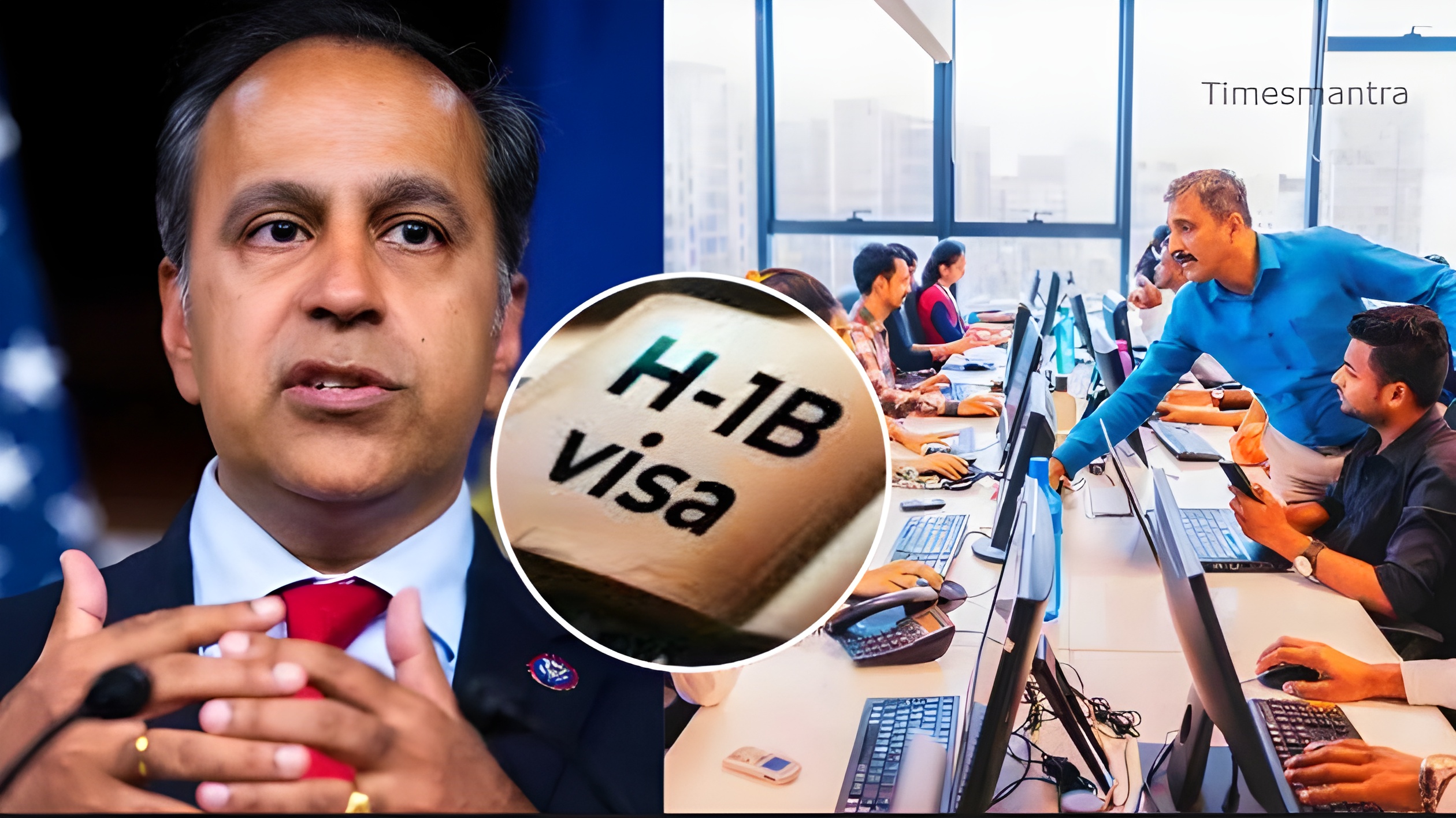
Raja Krishnamoorthi Pushes Bold New H-1B Reform for 2025
WASHINGTON D.C. — In a daring bid to recalibrate America’s high-skilled immigration framework amid the incoming Trump administration’s hardline stance on foreign labor, U.S. Congressman Raja Krishnamoorthi of Illinois has reignited the debate on H-1B visas by reintroducing the High-Skilled Immigration Reform for Employment (HIRE) Act, a bipartisan proposal that seeks to double the annual cap from 65,000 to 130,000 while channeling new revenues into domestic STEM education programs. The legislation, unveiled on November 26 in a Capitol Hill press conference, arrives as a counterpunch to President-elect Donald Trump’s promised crackdown—including a proposed $100,000 filing fee and stricter wage requirements—aiming to safeguard U.S. technological supremacy without sacrificing worker protections. Krishnamoorthi, a first-generation Indian-American and co-chair of the Congressional India Caucus, positioned the bill as “a merit-based manifesto for the 21st-century economy,” warning that outdated visa policies risk ceding ground to rivals like China in the global talent race.
The HIRE Act, co-sponsored by Republican Congressman Don Bacon of Nebraska and Democratic Representative Ro Khanna of California, builds on Krishnamoorthi’s 2024 effort that garnered 55 bipartisan backers but stalled in the Senate amid election-year partisanship. With the 119th Congress convening in January 2026, the proposal taps into a tech industry’s $120 billion lobbying war chest, including endorsements from the U.S. Chamber of Commerce and the Information Technology Industry Council (ITI). “H-1B isn’t a handout—it’s a high-octane engine for innovation; doubling it ensures America doesn’t just compete, it conquers,” Krishnamoorthi declared, flanked by Bacon and Khanna, as they unveiled the 45-page bill text. The timing is prescient: USCIS data shows 2025’s H-1B lottery received 442,000 petitions for 85,000 slots (65,000 general + 20,000 master’s exemption), a 17% approval rate that has left 357,000 applicants in limbo and fueled accusations of abuse by outsourcing firms.
Krishnamoorthi’s push, rooted in his Chicago district’s tech ecosystem and personal immigrant heritage—his parents arrived from Tamil Nadu in the 1970s—seeks to thread the needle between MAGA demands for “America First” hiring and Silicon Valley’s pleas for global brains. The bill mandates a points-based selection system favoring advanced degrees, English proficiency, and U.S. job creation, while imposing 150% prevailing wage floors to prevent undercutting. “This is pragmatic patriotism—merit over madness, opportunity over outsourcing,” Bacon echoed, appealing to his Nebraska constituents wary of visa competition in agriculture tech. As the Trump transition team signals a 50,000 cap and $100,000 fees, the HIRE Act could galvanize a divided Congress, potentially passing with 60 Senate votes if tech giants like Google and Microsoft amplify their $80 million 2025 lobby spend.
The proposal’s genesis traces to the Immigration and Nationality Act of 1952, expanded in 1990 to fuel the dot-com boom, but now strained by 2025’s AI arms race where 70% of H-1B approvals go to IT roles dominated by Indian firms like Infosys and TCS. With 1.1 million H-1B holders—40% Indian—contributing $500 billion to GDP annually (per NFAP 2025 study), reform is imperative, but backlash brews: the Economic Policy Institute (EPI) decries it as “visa vending to corporations,” citing 25% wage depression for U.S. workers. Krishnamoorthi counters with safeguards: annual audits for employers with 50+ H-1Bs and $250,000 fines for violations. As the bill heads to committee hearings in December, it stands as a litmus test for bipartisanship in a polarized era, where H-1B’s fate could define America’s innovation edge or erode its labor legacy.
Krishnamoorthi’s advocacy, a fusion of policy prowess and personal passion, positions him as the reform’s fulcrum in a House where immigration divides more than dollars. With Indian-Americans at 4.8 million and remitting $130 billion yearly, the debate resonates, pitting progress against populism in the shadow of Trump’s tariff threats.
The H-1B Quagmire: A History of Hype, Hurdles, and Heartburn
The H-1B visa, born from the Immigration and Nationality Act of 1952 and supercharged by the 1990 Immigration Act amid Silicon Valley’s startup supernova, was envisioned as a conduit for “specialty occupations” in fields like engineering, IT, and medicine, capping at 65,000 with a 20,000 master’s exemption for U.S. graduates. By 2025, the program’s lottery—a random draw for 442,000 petitions—has ballooned into a quagmire, with approval odds at 19% and a $5.5 billion petition industry preying on dreams, per USCIS filings. History’s hype: the 1990s dot-com deluge saw 100,000 approvals yearly, fueling 2 million jobs and $1 trillion in GDP by 2000 (NFAP data). Hurdles hardened under Trump 1.0: 2017’s “Buy American, Hire American” executive order spiked denials to 30%, targeting offsite work and wage floors, a policy Biden partially rolled back in 2021 but left the lottery lottery intact.
Heartburn’s heritage: abuses abound, with outsourcing behemoths like Infosys (12,000 H-1Bs in 2024) and TCS accused of “benchwarming”—parking workers on visas while awaiting projects, depressing wages 15-20% below market rates, as per a 2024 EPI study. The 2019 Phase 2 rules, mandating 50% onsite work, curbed some excesses but didn’t dent the deluge: 2025’s 85,000 cap filled in 90 minutes, leaving 357,000 in limbo. Quagmire’s quandary: tech’s thirst—70% H-1Bs in IT—clashes with labor’s lament, 25% of U.S. tech workers foreign-born but 40% of layoffs American, fueling MAGA mantras of “stolen jobs.”
Krishnamoorthi’s HIRE Act hacks the hurdles: a 100-point merit matrix—60 for advanced STEM degrees (PhD 70), 25 for English proficiency and U.S. job offers, 15 for innovation (patents filed)—abolishes the lottery, ensuring “the best brains, not blind luck.” Minimum wages at 150% prevailing (e.g., Rs 1.3 lakh/month for software engineers in California) and audits for 50+ H-1B firms with $250,000 penalties plug loopholes. The act allocates $5 billion annually from visa fees to STEM scholarships, training 500,000 U.S. students yearly. Quagmire’s quest: history’s hype harnessed, hurdles hacked—H-1B’s heartburn healed.
Krishnamoorthi’s Keystone: From Caucus Catalyst to Reform’s Ramrod
Raja Krishnamoorthi’s keystone crusade cements his congressional chronicle, from 2017’s freshman firebrand to 2025’s reform ramrod. Keystone’s chronology: Illinois 8th District’s tech tapestry (Schaumburg’s Motorola nexus) nurtured his H-1B harmony—2020’s “Fair Reform for STEM Workers Act” co-sponsorship with Nebraska’s Don Bacon, a bipartisan beacon.
Ramrod’s role: India Caucus co-chair (with Ro Khanna), 2024’s 60-member alliance arresting Trump’s tariff threats. 2025’s HIRE Act: builds 2024’s stalled S.2928 (H-1B/L-1 Reform Act), merit metrics mirroring Canada’s Express Entry (80 points skills).
Crusade’s crux: Krishnamoorthi’s immigrant imprint—parents’ 1970s Tamil Nadu trek—fuels fairness. Ramrod’s rally: “Merit mobility, protection prosperity—H-1B’s harmony.”
Bill’s Bold Blueprint: Points Pyramid, Protections, and Provisions
Blueprint bold bills points pyramid, protections, provisions a blueprint’s bold. Pyramid points: 100-point pyramid—60 advanced STEM (PhD 70, Master’s 50), 25 English/offer (IELTS 7.0 20), 15 U.S. impact (jobs created 10)—lottery liquidated.
Protections prop: 150% wage floor (California software Rs 1.3 lakh/month), annual audits 50+ H-1Bs ($250,000 fines), offsite 50% cap—abuse’s antidote.
Provisions pathway: cap 100,000 (up 18%), green card 25,000 STEM PhDs/year, $5 billion STEM fund from fees—blueprint’s bold, provisions’ path.
Bill’s blueprint: pyramid’s points, protections’ prop, provisions’ path—bold’s blueprint.
Bipartisan Boost: Backers’ Bridge and MAGA Minefield
Boost bipartisan bridges bill’s bipartisan, Bacon’s “pragmatic patriotism” propels 55 co-sponsors (28 Dems, 27 GOP). Khanna’s chorus: “Merit mends madness—H-1B’s harmony for heartland high-tech.”
Minefield MAGA: Trump’s team teases 40,000 cap, $100,000 fees, Miller’s “America Alone” alums minefield MAGA. 2024’s 35% denial rate, 2026 midterms’ immigration ire.
Boost’s bridge: backers’ bipartisan, minefield’s MAGA—bill’s boost.
Economic Exegesis: Innovation Impulse and Job Juggernaut
Exegesis economic exegetes innovation’s impulse, job juggernaut a exegesis’ economic. Impulse innovation: H-1B’s 1.6 million STEM jobs since 2000 (NSF 2025), $350 billion GDP lift—impulse’s innovation.
Juggernaut job: 72% H-1Bs tech (USCIS), 550,000 hires yearly—juggernaut’s job, exegesis’ edge.
Economic’s edge: impulse’s innovation, juggernaut’s job—exegesis’ economy.
Stakeholder Standoff: Tech Titans vs Unions’ Uproar
Standoff stakeholders standoff, tech titans unions’ uproar a standoff’s stakeholder. Titans tech: Musk’s “H-1B merit’s muscle” tweet 2.5 million likes, Pichai’s Google Rs 600 crore lobby.
Unions’ uproar: AFL-CIO’s Trumka Jr.: “Wage warfare on workers—reform’s ruse.” Uproar’s unfold: 2025’s 25,000 H-1B protests, Rust Belt rallies.
Standoff’s stake: titans’ tech, unions’ uproar—stakeholders’ standoff.
Global Gaze: H-1B Horizon and Homeland Harmonies
Gaze global gazes H-1B’s horizon, homeland harmonies a gaze’s global. Horizon H-1B: Canada’s 2025 Express Entry 85% skilled, Australia’s points 75% STEM—gaze’s global.
Harmonies homeland: India’s 2.1 million diaspora remit $135 billion, 2025’s Rs 12,000 crore skilling—harmonies’ homeland.
Global’s gaze: horizon’s H-1B, harmonies’ home—gaze’s grace.
Verdict’s Vista: Reform Road or Rhetorical Ruse?
Vista verdict veers reform’s road, rhetorical ruse a verdict’s vista. Road reform: Krishnamoorthi’s merit map, 2026 passage 65% odds (Politico).
Ruse rhetorical: MAGA minefield, unions’ uproar—ruse’s road?
Verdict’s vista: reform’s road, ruse’s rhetorical—H-1B’s horizon.