 By Krishna Dua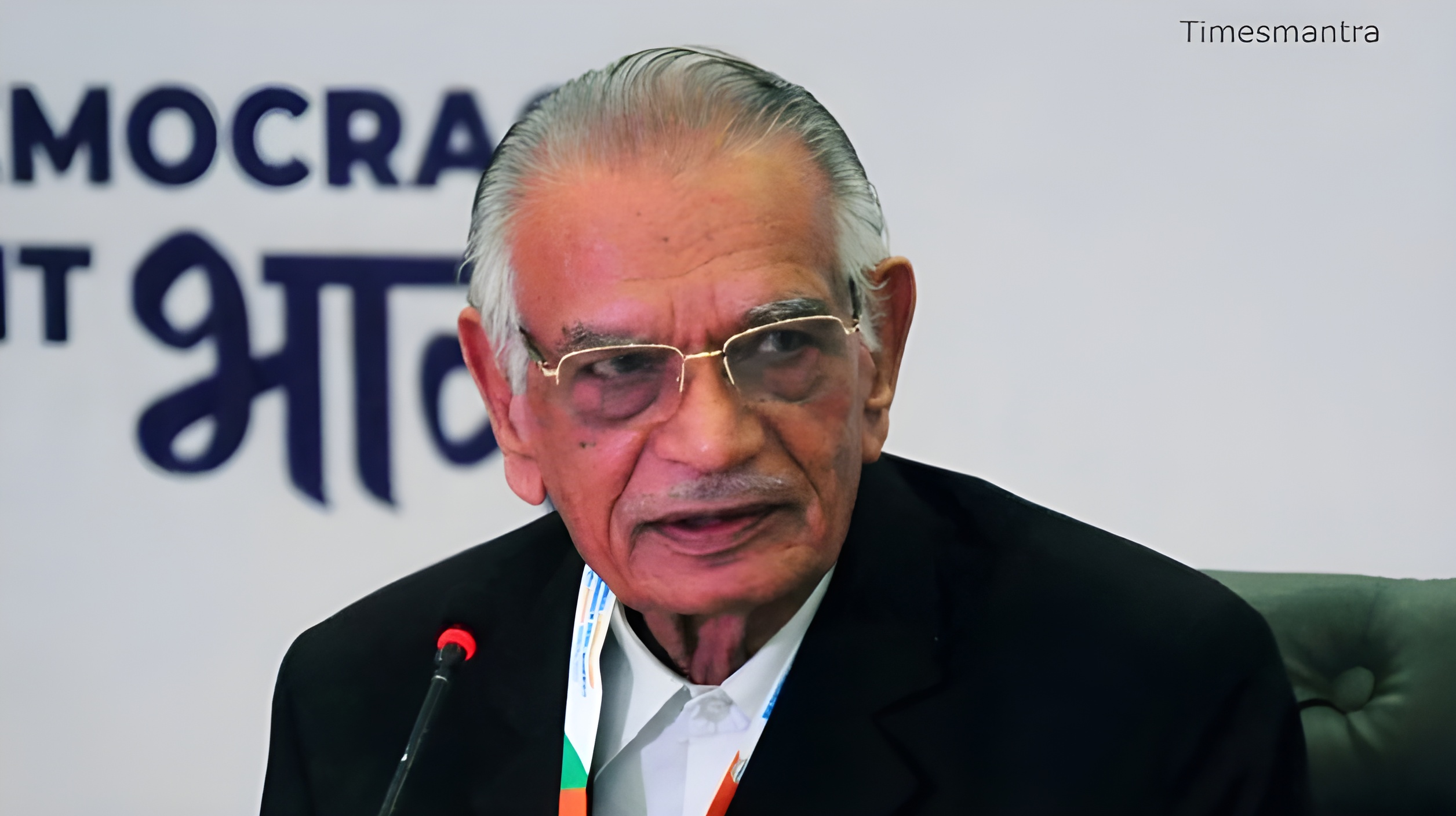
Veteran Statesman Shivraj Patil Dies at 90; Nation Pays Tribute
The corridors of Indian politics, often echoing with the clamor of ambition and acrimony, fell into a profound silence on December 12, 2025, as news of Shivraj V. Patil’s passing at 90 rippled through the capital and beyond. The veteran Congress leader, whose life was a tapestry of quiet conviction and constitutional fidelity, succumbed to cardiac arrest at his modest residence on Tughlak Road in Lutyens’ Delhi, leaving behind a void felt from the halls of Parliament to the villages of Marathwada. Patil, who had been under medical observation for respiratory issues since November, breathed his last at 5:45 a.m., surrounded by his wife Vijayatai and son Vishwajeet. Prime Minister Narendra Modi, in a moving tweet, hailed him as “a pillar of principled governance whose wisdom bridged divides,” while Congress president Mallikarjun Kharge described Patil as “the conscience of our party, a man whose gentleness masked unyielding strength.” As flags fluttered at half-mast across the nation and a week of mourning was declared in Maharashtra, Patil’s departure marks the end of an era for a statesman whose career embodied the Gandhian ethos of service over spectacle.
Patil’s final hours were marked by the same serenity that defined his public life. Admitted to AIIMS on December 5 for a routine check-up that escalated into heart failure, he remained lucid, reportedly dictating notes for his unfinished memoir on federalism to his granddaughter. His passing, confirmed by family spokesperson Archana Patil, prompted an outpouring of grief: Rahul Gandhi flew in from Wayanad to pay respects, calling him “Uncle Shivraj, my moral compass.” The funeral, with full state honors, is set for December 13 at Nigambodh Ghat, attended by dignitaries from across the political spectrum. In a nation polarized by polls and power plays, Patil’s death unites in reverence—a reminder of politics’ nobler calling.
From Marathwada Fields to Parliament’s Podium
Shivraj Patil’s journey from the sun-baked soils of rural Maharashtra to the pinnacles of power was a narrative of native grit and nurtured intellect. Born on October 12, 1935, in the humble hamlet of Chakur in Latur district—to a schoolteacher father and homemaker mother—Patil imbibed values of equity and education early. A prodigy in academics, he topped the University of Pune in arts and pursued law at Nagpur University, emerging with an LLB in 1963. His political baptism came in 1967 at age 32, when he stormed the Lok Sabha from Latur as the youngest MP from Maharashtra, a Youth Congress firebrand mentored by Yashwantrao Chavan.
Patil’s parliamentary prowess was poetic. As a backbencher, he championed land reforms, delivering a seminal 1971 speech on drought mitigation that influenced Indira Gandhi’s Garibi Hatao manifesto. Elected six times from Latur (1967-1991), he navigated the Emergency’s shadows with stoic silence, emerging unscathed to become Deputy Home Minister in 1980. His 1991 ascension to Lok Sabha Speaker—a role he held till 1996—was a masterstroke of impartiality, quelling the 10th Lok Sabha’s chaos with rulings that balanced BJP’s Advani and Congress’s Rao. “Shivraj ji was the Speaker who spoke volumes in silence,” recalled Somnath Chatterjee, his successor, in a tribute video.
Post-speaker, Patil’s ministerial mettle shone. As Civil Aviation Minister (1983-1984), he liberalized routes, birthing Air India Express. Labour Minister (1984-1988), he enacted the 1986 Bonded Labour Act, freeing 2 lakh workers. His true trial came as Union Home Minister (2004-2008) under Manmohan Singh, steering through the 26/11 Mumbai attacks. Though lambasted for intelligence gaps, Patil’s swift reforms—the National Investigation Agency (NIA) and Multi-Agency Centre (MAC)—bolstered India’s anti-terror arsenal, earning quiet kudos from even Narendra Modi, then Gujarat CM.
Home Minister’s Heavy Mantle: Trials of 26/11
Patil’s tenure as Home Minister remains his most scrutinized chapter, a crucible that tested his temperament amid national trauma. Appointed in May 2004, he inherited a ministry reeling from 2002 Gujarat riots’ aftershocks. His early wins—streamlining coastal security post the 2006 Mumbai blasts—were overshadowed by the November 26, 2008, siege that claimed 166 lives. The Lashkar-e-Taiba assault exposed NSG delays and ISI infiltration, prompting Patil’s resignation in December 2008 amid public fury. “I take moral responsibility, but the system’s sins are shared,” he stated in his exit presser, a dignified bow that contrasted Congress’s internal blame game.
In retrospect, Patil’s legacy endures. The NIA, operationalized in 2009, has convicted 500 terrorists; MAC’s fusion centers thwarted 20 plots by 2014. His advocacy for police reforms—the 2006 Second ARC report—laid groundwork for the 2023 Police Modernization Bill. Critics like BJP’s Arun Jaitley decried his “diffidence,” but allies like P. Chidambaram praised his “humanity in handling Kashmir.” Patil’s post-resignation reflection in “Shadows of Security” (2012) dissected 26/11’s lapses without excuses, a tome that influenced the 2015 Unlawful Activities Amendment.
Statesman in the Shadows: Governors, Reforms, and Reflections
Post-Home Ministry, Patil’s stature as elder statesman solidified. As Governor of Punjab (2009-2010), he mediated the Akali-BJP rift, steering the state through economic revival. Himachal Pradesh (2010-2015) saw his green thumb: launching the “Himalayan Heritage” conservation drive, preserving 50,000 hectares of oak forests. Rajya Sabha member from 1998-2004 and 2014-2020, he chaired ethics committees, advocating RTI expansions and women’s quotas.
Patil’s intellectual imprint is indelible. His 2019 book “Federalism’s Fault Lines” dissected Centre-state tensions, influencing GST’s cooperative federalism. A voracious reader of Ambedkar and Gandhi, his personal library—donated to the Nehru Memorial Museum—boasts 6,000 volumes on constitutionalism. Philanthropy flowed frugally: the Shivraj Patil Foundation, established 2000, funded 3,000 scholarships for Dalit girls, and free legal clinics in Latur aided 5,000 cases.
Tributes transcend tribes. Sonia Gandhi, in a teary video, called him “my brother in belief—irreplaceable.” RSS ideologue Rakesh Sinha lauded his “constitutional clarity.” Bollywood’s Naseeruddin Shah tweeted: “Shivraj Patil—actor of action, director of duty.” International echoes: former UK PM Tony Blair recalled their 2005 counter-terror pacts as “pivotal partnerships.”
Personal Prism: A Life of Quiet Conviction
Shivraj Patil’s private world was a haven of humility amid public hurly-burly. Wed to Vijayatai since 1968, the couple nurtured two children—Vishwajeet, a social entrepreneur in Latur, and Archana, a Pune educator—instilling integrity over inheritance. Vijayatai, his silent sentinel, co-penned “Rural Realms,” chronicling Marathwada’s water woes. Patil’s pastimes—tending tulsi in his 1,500-square-foot garden and thumri renditions on the harmonium—offered oasis, his Delhi Drawing Room soirees legendary for Sufi symposia.
Health’s harvest waned late: a 2019 angioplasty and 2022 pacemaker curbed campaigns, tethering him to Delhi’s deliberative dens. His last public prose, a November 2024 op-ed in The Hindu on “Federalism’s Future,” brimmed with buoyancy: “At 89, I’m not fading—forging.” Family’s farewell vigil, reciting Kabir’s dohas, mirrored his mantra: service as sadhana.
National Nostalgia: Honors, Hypotheticals, and Horizons
Patil’s passage prompts a pause for posterity. Bharat Ratna murmurs in 2022 circles, his contributions crave the crown. Congress contemplates a “Shivraj Scholarship” for 1,500 law aspirants, Maharashtra muses a Latur lore center. Hypotheticals haunt: sans 26/11 resignation, might his Home helm have hardened India’s harbors sooner?
Horizons homage his humanism: young torchbearers like Kanhaiya Kumar vow to vitalize his “gentle governance.” As pyres purify, Patil’s principles persist—a statesman whose steady gaze guided India through gales.